Benchmarks usually measure the good day. Fast server, no limits, every page where you left it. That’s the day you don’t need help.
So we measured the other days. The site that tells you to slow down. The crawl that dies two hours in. The page that only shows its products as you scroll. The Tuesday the shop ships a redesign and your price column goes quiet.
Two kinds of comparison run through this post, and they answer different questions. At defaults, each tool runs the way it ships, which is what you get if you install it and go. At the same settings, the tools are made to behave alike, so what’s left is how well each does the same job. Every result below says which kind it is, and so does every panel of the chart.
Here’s the short version, then the long one.
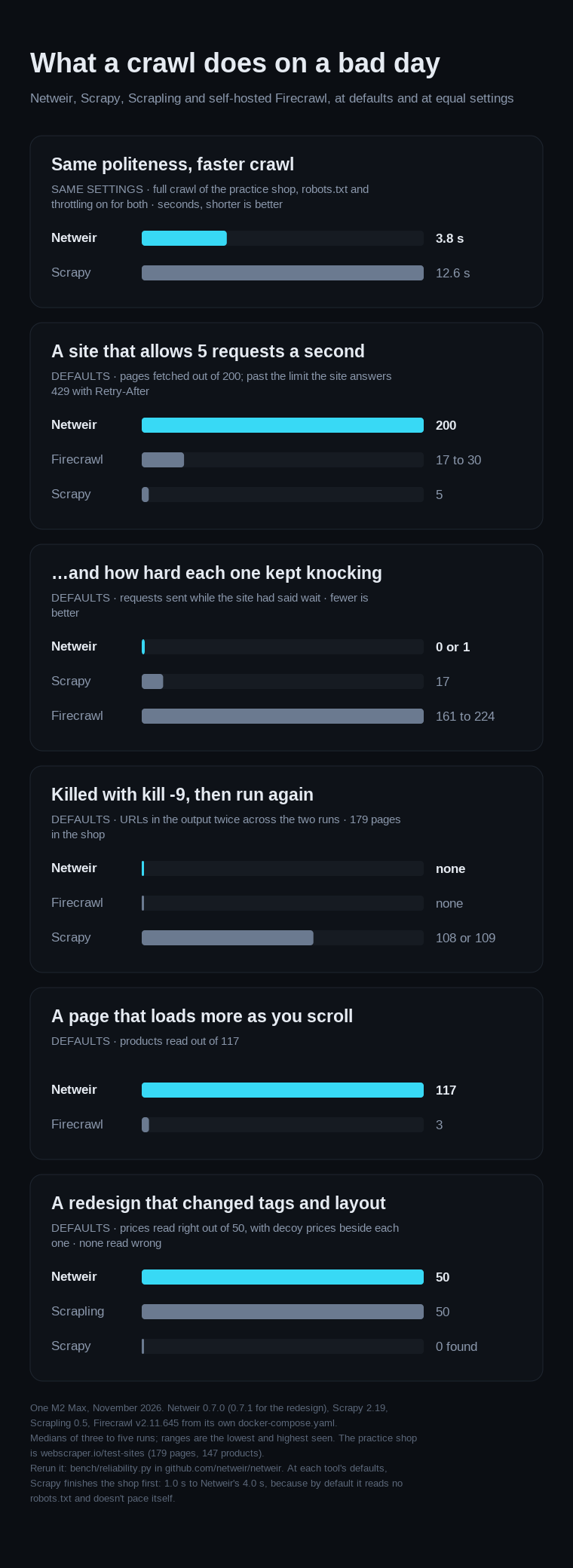
bench/reliability.py, and the tables below have the full results. There's a wide version for sharing.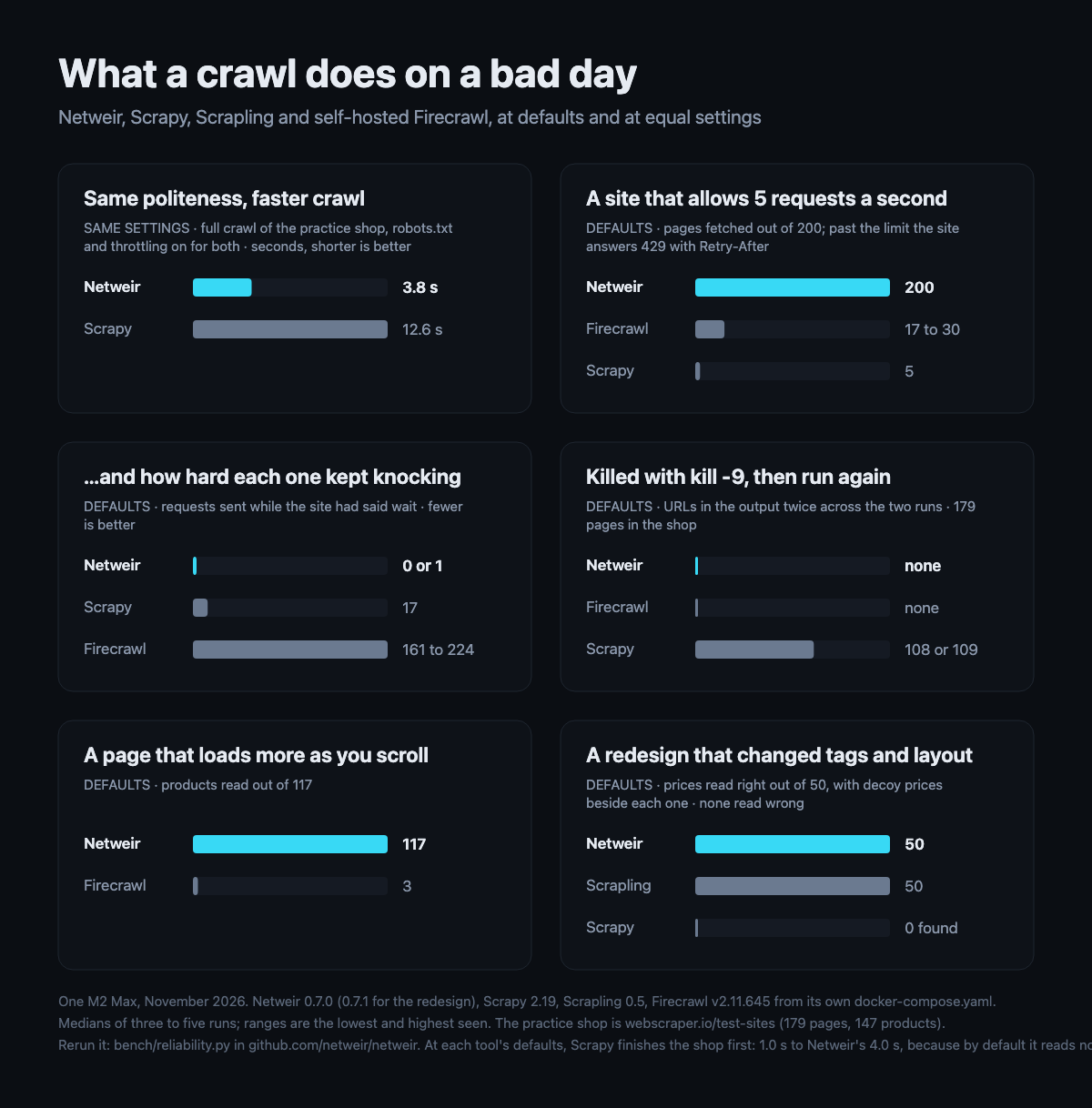
The bench
Every test ran on one machine in November 2026, against four tools:
- Netweir 0.7.0, and 0.7.1 for the redesign test, which needs a fix that shipped there.
- Scrapy 2.19.0 on Twisted 26.4.0, the crawler most of us grew up on.
- Scrapling 0.5, for the redesign test, because its
adaptive=Trueis the closest thing to Netweir’strack=. - Firecrawl v2.11.645, self-hosted from its own
docker-compose.yaml. Self-hosting puts it on the same machine as the others, and lets anyone rerun the numbers. We didn’t test the hosted service.
Each tool runs on its own defaults unless a test says otherwise. Timings are medians of three to five runs. Where a result moved between runs, you get the lowest and highest we saw, not a flattering middle.
Defaults matter here, so these are the ones in play:
| Netweir 0.7.0 | Scrapy 2.19.0 | Firecrawl v2.11.645 | |
|---|---|---|---|
| Requests in flight | 64 in all, 8 per site | 16 in all, 8 per site | 5 jobs at once, 10 pages per crawl, 8 workers per queue |
| robots.txt | read and obeyed | not read | read and obeyed; skipping it is an enterprise feature |
| Pacing | adapts to how fast the site answers, starting at 1 s | none (DOWNLOAD_DELAY 0, AutoThrottle off) |
as it ships; we set nothing |
| Retries | waits as Retry-After says |
2 retries, at once, on 429 and 5xx | as it ships; we set nothing |
And the machine they shared:
| Computer | Apple M2 Max, 12 cores, 32 GB |
| OS | macOS 26.7.1 (25G241) |
| Python | 3.12.11, for Netweir, Scrapy and Scrapling |
| Docker | Docker Desktop with engine 29.8.2; its VM had 12 CPUs and 7.7 GB |
| Firecrawl’s limits | from its compose file: the Playwright service 2 CPUs and 4 GB, the API 4 CPUs and 8 GB; Redis, RabbitMQ and Postgres unlimited |
Firecrawl’s limits are worth a second look. Its browser service is capped at 2 CPUs, and it renders pages there even when the page doesn’t need a browser, so that cap is where much of its time goes. We left it as it ships. Raising its job and worker limits tenfold didn’t change its time, which is the test below.
Four tests use the public practice shop at webscraper.io/test-sites: 179 pages, 147 products, and a robots.txt we stay inside. That shop never rate-limits or gets redesigned, so those two tests serve their own pages locally.
A full crawl, at each tool’s defaults
All three fetched 179 of 179 pages.
| Seconds | Peak memory | |
|---|---|---|
| Netweir | 4.0 | 47 MB |
| Scrapy | 1.0 | 117 MB |
| Firecrawl | 59 | about 3 GB across its containers |
Scrapy wins this one, and it’s worth saying why rather than skipping past it. Out of the box, Scrapy doesn’t read robots.txt and doesn’t pace itself. Netweir does both. On a practice shop, that politeness costs three seconds. On somebody’s real store, it’s the difference between a crawl and a complaint.
Firecrawl took about a minute however we set it. With its limits raised tenfold (50 jobs at once instead of 5, 32 workers instead of 8) it took just as long.
The same crawl, at the same settings
Give both crawlers the same manners and the order flips.
| Polite (robots.txt and throttling on) | Neither | |
|---|---|---|
| Netweir | 3.8 s | 0.26 s |
| Scrapy | 12.6 s | 0.69 s |
For Scrapy, “polite” means ROBOTSTXT_OBEY and AUTOTHROTTLE_ENABLED, its own switches for the behaviour Netweir has on by default. Polite or not, Netweir is faster: 3.3 times with manners on, 2.7 times with them off.
A site that says slow down, at defaults
This site allows 5 requests a second. Past that it answers 429 Too Many Requests with Retry-After: 1, which is the site asking, politely, for a second’s peace. It has 200 pages.
| Pages fetched | Requests sent during a Retry-After | |
|---|---|---|
| Netweir | 200 | 0 or 1 |
| Scrapy | 5 | 17 |
| Firecrawl | 17 to 30 | 161 to 224 |
Netweir took about a minute: the site’s limit, plus its own backoff. Scrapy retries a 429 twice, straight away, then gives up on the page, so it came home with 5. Firecrawl kept knocking while the door said wait, up to 224 times in a run, and got 30 pages at best.
At a gentler 20 requests a second, Netweir and Firecrawl both fetched all 200 pages. Netweir took 20 to 24 seconds and Firecrawl 15 to 25. Scrapy got 20 to 40.
A crawl that’s killed, then run again, at defaults
We stopped each crawl a third of the way through and started it again. Netweir and Scrapy keep their state in a folder (checkpoint= and JOBDIR). For Firecrawl, we stopped and restarted its API container.
| After a clean stop | After kill -9 |
|
|---|---|---|
| Netweir | 179 pages, none twice | 179 pages, none twice |
| Scrapy | 179 pages, 2 twice | 107 pages on one run; 179, with 108 or 109 twice, on two |
| Firecrawl | 179 pages, none twice | 179 pages, none twice |
Netweir and Firecrawl tie here, and both are spotless. Scrapy does exactly what its documentation promises: a resume after a clean stop. A kill -9 isn’t a clean stop, and more than half the shop came back twice. Firecrawl’s queue lives in its Postgres container, so a job outlives the API.
What “none twice” measures is narrower than it sounds. We counted the URLs in each tool’s output after the second run. That shows nothing was written out twice. It doesn’t show that no page was requested twice on the wire, since this shop isn’t ours and we can’t see its logs. And it says nothing about anything outside the crawl, such as a webhook or a database write in your own code, happening exactly once. If those matter to you, make them idempotent whichever tool you use.
A page that loads more as you scroll, at defaults
The shop’s laptop page shows 117 products, a few at a time, as you scroll.
| Products read | |
|---|---|
| Netweir, scrolling in Chrome | 117 |
| Firecrawl, self-hosted | 3 |
Scrolling is one of Firecrawl’s page actions, and self-hosted, those need Fire Engine, a separate engine its self-hosting guide leaves you to connect. Its hosted service has actions; we didn’t test it.
A redesign, at defaults
Each tool learns where the price lives on 50 product pages. Then the pages change and each reads them again. Every page also carries a “was” price and a shipping price beside the real one, so a tool that guesses gets caught.
| Classes renamed | Classes, tags and layout changed | |
|---|---|---|
Netweir, track= |
50 right, 0 wrong | 50 right, 0 wrong |
Scrapling 0.5, adaptive=True |
50 right, 0 wrong | 50 right, 0 wrong |
| Scrapy | 0 found | 0 found |
Netweir and Scrapling tie, perfect on both. Scrapy’s selector simply stops matching, which is the empty price column you find on a Tuesday. Firecrawl isn’t in this table, because it reads fields with a language model and the self-hosted setup here has none.
The second column needs Netweir 0.7.1. On 0.7.0, a price that moved from a <p> to a <span> was lost.
What the numbers add up to
On a good day, at defaults, Scrapy is quickest, and it’s polite manners that cost Netweir the time. On every bad day we tried, Netweir finished with the whole site:
- faster than Scrapy at the same settings, by 2.7 to 3.3 times;
- every page behind a rate limit, without leaning on the door;
- no URL written out twice after a
kill -9; - every product on an infinite scroll;
- every price right after a redesign.
Where it didn’t win, the post says so. Scrapy is quicker at defaults on a good day. Firecrawl matched it on resuming, and at a gentler 20 requests a second it was sometimes quicker. Scrapling matched it on redesigns. No one tool matched it on all of them.
Where this is narrow
These results come from one practice shop, a handful of failure servers running on the same laptop, and one machine. They show how each tool behaves in those cases, not how it does on every site you’ll meet. Two of the four tools appear in only some tests: Scrapling in the redesign, and Firecrawl wherever it could run self-hosted. And all of it was run by us, the people who make one of the tools, so treat it as a claim to check, not a verdict.
The next round widens it. It moves to a practice site of our own, with more shops, pages that need a browser, logins and forms, and more tools. If you rerun any of this and get different numbers, we’d like to see them.
Run it yourself
The script is bench/reliability.py, and the README and the benchmarks page carry the same results. Its docstring says how to start Firecrawl. It runs against someone else’s practice shop, so it stays on the paths their robots.txt allows. Please don’t run it in a loop.
The next run, in about a week, brings in more of the field: Crawlee and Crawl4AI, Spider, Playwright and Puppeteer for the browser tests, and Colly. If there’s a tool or a bad day you want in it, tell us in Discussions.